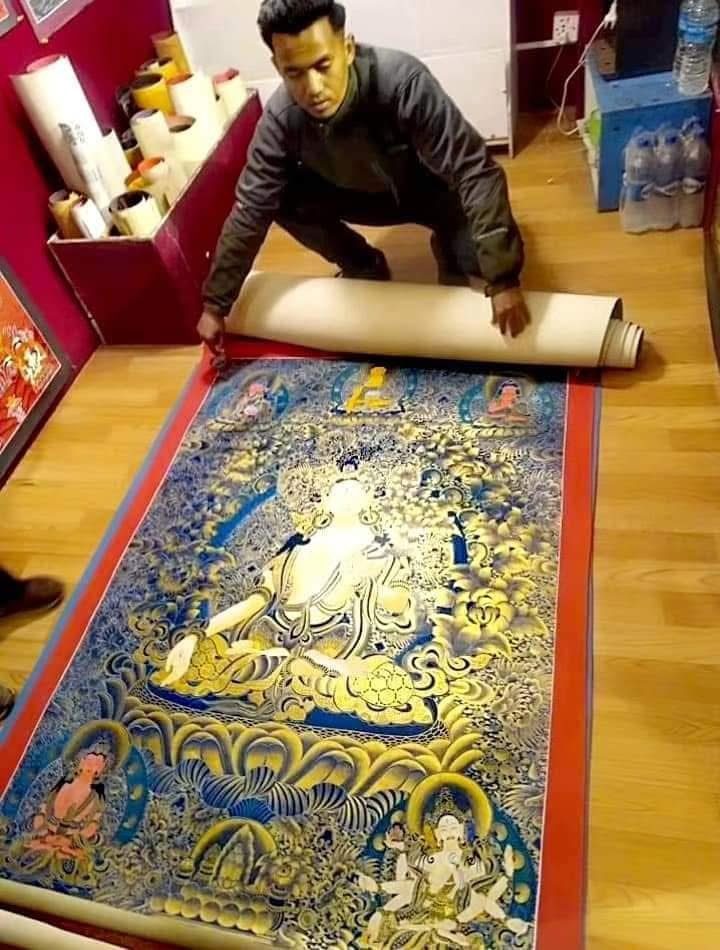
How a thangka is made in our family workshop
From the first grid lines to the opening of the eyes — every canvas passes through three generations of hands.
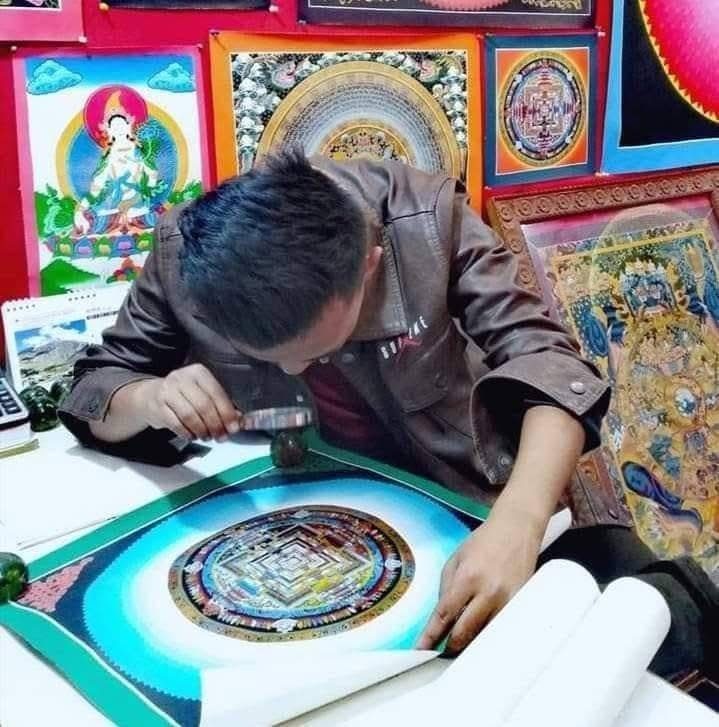
My father began learning thangka painting in his early teens. Today he leads a traditional workshop of 15 to 20 artisans, and I grew up inside that studio. This is how a painting moves through our family.
1. Grid and proportion
Every deity is laid out on a precise grid. The proportions — the width of the face, the length of the arms, the size of the halo — follow measurements that painters have used for centuries. Get this wrong and nothing after it can be right.
2. The sketch
On top of the grid the figure, the lotus throne and the landscape are drawn by hand, then corrected and refined line by line.
3. Colour blocking — my mother and me
This is the stage my mother and I are responsible for. We lay in the foundational colours: the sky, the hills, the robes and the skin. It is slow work, built up in layers, and it decides how the finished painting will glow.
4. Specialised sections — our artisans
Clouds, shading, brocade patterns and fine ornament are painted by artisans who have spent years on exactly these details.
5. Gold and the eyes — my father
My father does the final detailing and gold line work. The eyes are painted last. When they are opened, the painting is finished.
Every canvas passes through three generations of hands before it leaves our studio.
Because every piece is painted in our own workshop, we can tell you exactly who worked on it — and paint a custom version if you need a different size or palette.